REPORT | Summer 2026 in Foodservice: Results in Spain and International Trends.


The foodservice market is large, fragmented, and in constant motion. Restaurants, bars, coffee shops, hotels, takeout spots, hybrid formats, and new points of consumption all coexist inside it, so a single commercial approach rarely fits all of them.
For manufacturers and distributors, that raises a question with no easy answer.
Which part of the market is a fit for each product or category?
Not every foodservice establishment carries the same commercial value for a company, because fit depends on what each venue sells and to whom. A product can make a lot of sense in a coffee shop with heavy morning turnover and very little in a fine dining restaurant. A premium line can fit venues with a high average check and miss completely in bars serving a daily set menu.
A category built around brunch can also cluster in very different areas than a solution designed for professional kitchens.
Growing in the restaurant industry therefore depends on knowing where the opportunity is, which establishments belong to your potential market, and which areas deserve the most attention.
Market segmentation is what brings order to that picture.
Foodservice market segmentation is a marketing strategy that divides establishments into smaller, more homogeneous groups, called segments, that share needs, behaviors, or characteristics and call for a differentiated approach.
Put simply, segmenting means moving from “I want to sell into foodservice” to “I want to sell to these types of establishments, in these areas, with these characteristics, and with this level of fit for my product.”
That difference changes the entire way you work the market.
A list can tell you which venues exist. It can include the name, the address, the phone number, the venue type, or the city. That information has its uses, though it does not go far enough.
Why not?
Because a list leaves one question unanswered.
Which of those establishments are a fit for what you sell?
Take a company that sells products for coffee shops. Knowing how many bars or restaurants a city holds does not help much on its own. What it needs to know is which venues work breakfast, brunch, specialty coffee, pastries, smoothies, or morning and afternoon consumption occasions.
The same applies to other products.
A premium beverage brand needs to identify venues with a certain average check, a matching menu, and a particular kind of dining experience. A multi-product distributor needs to know which references can fit in each venue. A frozen food company may need to spot establishments with a specific offering, a given turnover, or a compatible venue type.
Good segmentation therefore does more than sort establishments. It tells you what the potential market is for a given product or category.
In foodservice, two venues can look alike from the outside and have very different commercial needs.
Two restaurants can sit on the same street, and both can show a healthy level of activity. Both can even appear in a database under the same label, “restaurant”.
One of them, however, may work a daily set menu with a low average check. The other may run a premium menu, seasonal produce, and a higher spend per diner.
For a company selling premium cuts of meat, those two venues are not worth the same. For a coffee brand, neither may be a priority. For a company selling solutions built around the daily set menu, the first one probably makes more sense.
Segmenting well therefore means crossing several layers of information:
Segmentation starts to earn its keep when it helps you identify which venues can form part of your potential market.
When a company tackles the market as a single block, the effort tends to be spread without much precision.
Sales could end up visiting areas with less upside, and Marketing could launch campaigns aimed at audiences that are far too broad.
Furthermore, leadership could plan an expansion on a skewed read of the market. The trade team, meanwhile, could struggle to justify which areas or categories deserve priority.
When the market is properly segmented, by contrast, those decisions fall into a much clearer order.
You can answer questions like these:
Segmenting foodservice lets you stop thinking in terms of volume alone and start thinking in terms of fit.
The goal is not reaching more establishments. It is reaching the ones that make the most sense for your product, your category, and your commercial strategy.
Many companies selling into foodservice have a rough idea of their market. They know which areas they sell best in and they know their regular customers. They have sales history, and they have the field experience of their team.
None of that is the same as knowing the potential market.
The distinction matters. Knowing where you sell today is one thing, and knowing where you could be selling is another thing entirely. The second question covers which establishments you have not identified yet and which areas hold the most potential for your categories.
The knowledge of a sales team is worth a great deal. An experienced rep knows how to read an area, which customers buy the most, and which profiles tend to have the strongest affinity for certain products.
Foodservice, however, is too large and too changeable to depend on individual perception alone. There are thousands of establishments, constant turnover, openings, closures, new menus, and new consumption habits.
Intuition should therefore complement segmentation rather than replace it. If every rep reads the market by their own criteria, the company can end up working from different pictures depending on the area or the team.
Plenty of companies try to bring order to the market with manual segmentation, using questionnaires filled in by the sales team, ABC categories, subjective ratings of sales potential, or internal classifications by customer type.
These systems work as a first approximation, though they tend to produce criteria that cannot be compared. One rep may weigh the average check more heavily, another the length of the relationship, another the expected purchase volume.
The problem does not necessarily sit with the team. It sits instead with a method that does not always allow opportunities to be compared under the same logic.
Establishments in the restaurant industry also change often, so a segmentation that is never revisited goes out of date.La segmentación empieza a ser útil cuando te ayuda a identificar qué locales pueden formar parte de tu mercado potencial.
A CRM is a genuinely useful tool for managing customers, contacts, visits, and opportunities. What it does not show, though, is the whole potential market.
There can be establishments with a strong fit that never made it into the database. There can also be areas that have barely been worked, mislabeled venues, duplicate records, or establishments that have already closed.
A company can therefore hold a CRM with plenty of records and still be missing a picture of every opportunity available in foodservice.
When there is no shared read of the potential market, each area decides from its own information. Sales looks at the account base and the visit plan. Marketing looks at audiences, campaigns, and categories, while leadership looks at growth, coverage, and budget.
Every one of those perspectives adds something. When they are not connected, though, they can pull in different directions on questions like which area to prioritize, which venue type fits a given product best, or where to launch a new category.
Without shared segmentation, those questions get answered from partial perceptions. Knowing the potential market is therefore what allows sales, marketing, and leadership decisions to line up.
Segmenting foodservice well starts with telling three concepts apart, because the total market, the potential market, and the target customer describe different things.
The three describe the same market at three levels of zoom. Everything that exists, then the part of it that fits what you sell, and finally the venues you walk into first.
The difference looks straightforward. It also heads off a common mistake, which is working the entire market as if every establishment carried the same value for your company.
The total market is every establishment that exists inside a defined area of analysis, whether that area is a country, a region, a city, a neighborhood, or a broad foodservice category.
If you analyze a city, for example, the total market can include restaurants, bars, coffee shops, hotels, takeout spots, and other formats tied to eating away from home.
This view tells you the overall size of the market, though it says nothing about whether those establishments are a fit for what you sell.
The potential market is the part of the total market that fits a product, a category, or a commercial strategy.
Here you are no longer looking at every establishment. Instead you are looking at the ones that meet certain criteria, such as venue type, area, average check, menu, culinary category, reputation, or affinity with your portfolio.
Instead of working thousands of establishments as if they all carried the same value, you can identify which segment deserves more attention.
The same company can also have several potential markets. A premium line, a high-turnover product, and a new category can each call for their own segmentation.
There is no single potential market, then. There is a different potential market for each objective.
The target customer is the specific establishment you can prioritize inside the potential market.
First you define which segment fits your product. Then you decide which individual venues should be worked first.
That second decision usually rests on practical criteria, so distance from an existing route, expected purchase volume, and how quickly a venue could take on a new reference all weigh into it.
The potential market helps you understand where the opportunity is, while the target customer helps you decide where to start.
When a company confuses the total market with the potential market, the effort usually gets misallocated. It can try to sell to too many venue types, or launch campaigns that are too broad.
Separating the concepts lets you move in order. First you size the environment, then you identify the segment with the strongest fit, and finally you prioritize specific establishments.
Foodservice brings together very different businesses, which is why a high-check restaurant, a coffee shop, a hotel, a takeout spot, and a food retail location do not have the same needs.
Working the potential market lets you concentrate resources on the profiles that make the most sense for your product and your strategy.
Useful segmentation in foodservice is not built on a single criterion. It needs to combine several layers of information to show which establishments fit each product, category, or commercial strategy.
Taken together, those layers are what turn a market you can describe into a market you can act on. The six that follow carry the most weight.
The first level is usually the type of establishment. Selling to restaurants is not the same as selling to bars, coffee shops, hotels, takeout spots, convenience stores, leisure venues, or impulse formats.
Each type has its own needs, its own purchasing rhythms, and its own consumption occasions, so segmentation has to capture those differences. That means how often a venue restocks, the volume it orders, and the time of day it sells.
Location also shapes the opportunity a great deal. A category can have a heavy presence in one city and almost none in another. It can even change from one part of the same city to the next.
Segmentation should therefore let you analyze the market by sales territory, region, city, commercial district, or neighborhood. The finer the geographic breakdown, the easier it becomes to decide which routes and which campaigns are worth the investment.
The average check tells you what kind of proposition each establishment works. A premium product, for instance, does not fit a low-check venue the way it fits a restaurant built around a more elaborate dining experience.
The reverse holds too. A reference designed for high turnover tends to make more sense in venues with more accessible prices and more frequent purchases.
In the restaurant industry, the menu carries a lot of information. It shows which products a venue works, which categories have a presence, and what kind of culinary offering it puts in front of diners.
Reading the menu is also what separates a real fit from an apparent one. A venue that lists potatoes on its menu is not automatically a prospect for a frozen fries supplier. Those potatoes may be going into an omelet rather than into a fryer.
Beyond knowing what a venue sells, it helps to understand how it behaves. Online reputation, diner satisfaction, review frequency, and activity signals therefore qualify each point of sale more accurately.
Segmentation can then weigh whether an establishment deserves priority within your commercial strategy. Two venues with an identical profile on paper can look very different once you read what their customers say about them.
Segmentation should do more than tell you whether an establishment belongs to a given type. It should also help you understand which products in your portfolio have the strongest fit in each type of venue.
Portfolio affinity means crossing two readings:
Segmentation can then identify which venues could be interesting and, on top of that, which part of your commercial offering makes the most sense for each group of establishments.
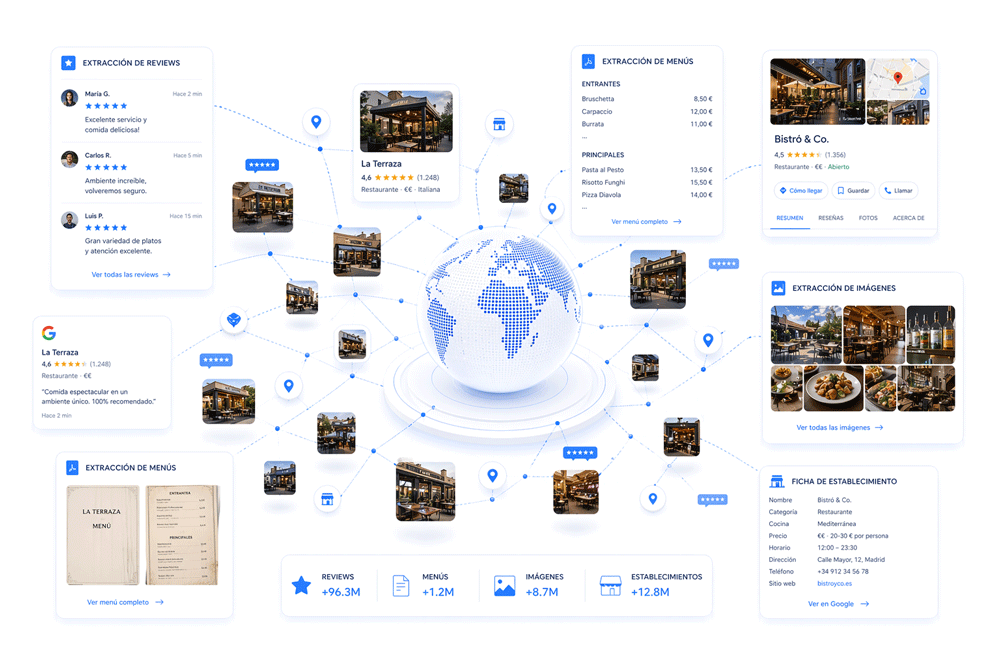
Once you know which variables make segmentation possible, the next step is capturing and organizing that information at scale.
A lot of useful foodservice information sits scattered across menus, reviews, images, websites, directories, and digital listings, so the work is turning it into variables that sales, marketing, and leadership can actually use.
That is a technology problem before it is a commercial one. The information is public, though it arrives unstructured, in different formats, and with no common way of describing the same venue twice.
Delectatech works from a foodservice census covering millions of establishments worldwide.
The census includes restaurants, bars, coffee shops, hotels, retail, takeout, leisure, and impulse formats, along with other businesses tied to eating away from home.
Starting from that base, Delectatech’s technology makes it possible to go from the full market down to far more specific segments. Establishments with a given category on the menu, a particular check range, or a commercially interesting area, for example.
To qualify each point of sale, Delectatech analyzes a range of digital market sources.
Those sources include menus, reviews, photographs, websites, directories, digital listings, and other public or semi-public signals from the channel.
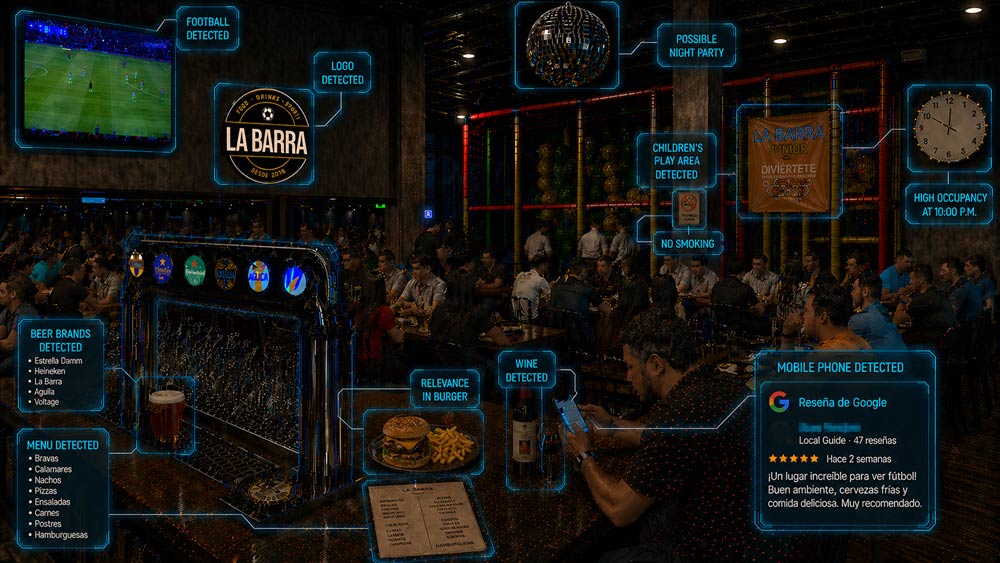
Together they build a detailed read of each establishment, covering what it sells, how it positions itself, what kind of experience it offers, and what its activity signals show.
Market information rarely arrives in an orderly state. A menu, for example, can live inside an image. A review can mention a product, and a photograph can show a brand or a type of offering.
That is why Delectatech uses its own technology, built on artificial intelligence, machine learning, and deep learning, to read, classify, and structure that data.
The system converts unstructured data into comparable variables, among them venue type, products, categories, average check, reputation, activity, and commercial affinity.
FoodRadar is Delectatech’s platform. Among other solutions, it lets you build segmentations of the total market according to the variables you choose, and obtain the corresponding potential market.
It is designed to help foodservice manufacturers and distributors interpret the market, segment it, and make better commercial decisions. It therefore fits within a broader idea of intelligent foodservice, where data supports informed decisions.
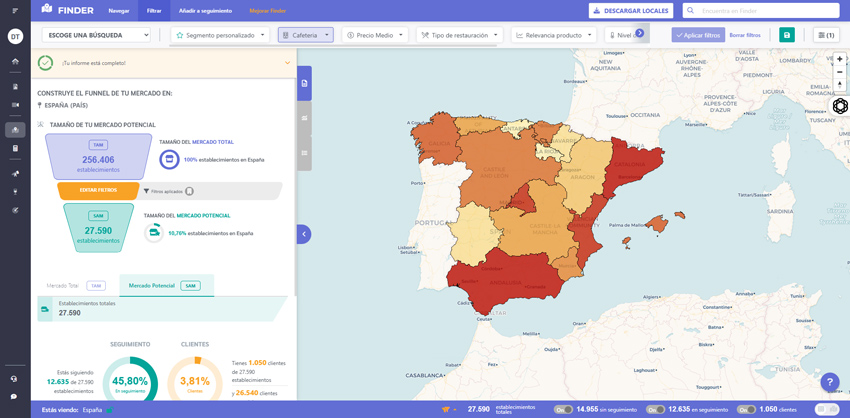
As we have seen, most foodservice manufacturers and distributors do not really know how many potential customers they have, where those customers are, or which areas they should prioritize.
Sales teams end up working with incomplete segmentations, poorly optimized routes, and campaigns that scatter resources.
Within Delectatech’s 4 foodservice solutions, SEGMENT was designed to solve that problem by turning foodservice into a map you can act on and measure. It helps manufacturers and distributors understand which part of the market fits each product, category, or commercial strategy.
SEGMENT identifies which foodservice establishments have the strongest affinity for a category, a product line, or a growth objective.
It starts from Delectatech’s foodservice census and applies segmentation criteria such as venue type, location, average check, menu, products on offer, reputation, and activity signals.
For a given segmentation, a company gets an exact read of how many establishments fit, where they are, and what characteristics they share.
The output is a defined universe rather than an impression. Instead of a general sense that a category works well in cities, you get a count of venues, their locations, and a description of what they have in common. That is the level of detail a commercial plan can be built on.
A foodservice database can tell you which establishments exist. SEGMENT goes a step further, because listing venues is not where it stops.
Its purpose is building segmentation you can decide with. It shows establishments and, beyond that, helps you understand what your potential market is for the product or category you want to work.
SEGMENT should not be read as a simple list, nor as generic foodservice software. It is instead a market intelligence layer built for manufacturers and distributors who need to segment, compare areas, and size opportunities.
The market changes continuously, since venues open, others close, menus change, new formats appear, and consumption habits shift.
Keeping the information current therefore matters. Delectatech’s census is updated quarterly, which lets you work from a regular read of the market and improve traceability across the channel.
That cadence also makes segmentations comparable over time. Running the same criteria two quarters apart shows whether a segment is growing, shrinking, or simply moving to a different part of the city.
SEGMENT is built for companies that sell into foodservice and need a better understanding of their potential market. That understanding comes before launching campaigns, prospecting new customers, or making expansion decisions.
It can add value to different company profiles, though each one uses it with a different need in mind.
The three profiles below are the ones where that need shows up most clearly. Each of them reaches the market in a different way, so each of them is missing a different piece of the picture.
For foodservice distributors, the challenge usually lies in managing broad portfolios across large sales territories.
A distributor can sell many different categories, including beverages, frozen goods, fresh produce, coffee, pastries, solutions for professional kitchens, and high-turnover references.
In that context, SEGMENT brings order to the market by area, venue type, category, and sales potential. The team can then see which establishment profiles fit each part of the portfolio best.
It also surfaces areas where there may be more commercial upside, so that not every segment gets worked at the same priority.
For manufacturers with a sales force, SEGMENT earns its place when they need to focus the sales team’s work, prepare a launch, or reinforce a category.
It can also help marketing and trade marketing design sharper campaigns. Instead of activating around an audience that is too broad, they can work on the segments with the strongest affinity.
Sales and marketing can then coordinate around the same read of the market.
Manufacturers without a sales force usually sell into foodservice through distributors, partners, or third-party agreements.
In those cases, SEGMENT gives them visibility over the market without depending solely on the information coming back through the distribution network.
That helps them decide which areas are worth reinforcing, which establishment types fit the product best, and which arguments the brand can pass on to its distributors.
It also lets them prepare launches with more context and steer territorial expansion, even without their own reps in the field.
One of the first questions SEGMENT answers is market size, meaning how many establishments form part of the potential market for a specific category.
That answer is especially useful when you want to launch a new line, reinforce a product, open an area, or check whether the available market justifies the commercial effort.
Market size is also the figure every other commercial ratio depends on. Coverage, share of the potential market, and cost per acquired customer all need a denominator before they mean anything.
Potential is not spread evenly across areas, because a category can have a heavy presence in some places and very little in others.
SEGMENT analyzes the opportunity by city, postal code, neighborhood, commercial district, or sales territory. That breakdown is therefore what turns a national figure into a route plan.
The same total can hide very different pictures, since eight hundred venues spread thinly across a country call for a different sales structure than eight hundred concentrated in four cities.
Knowing how many venues fit matters, though it is not enough on its own. You also need to understand what those establishments are like.
SEGMENT analyzes variables such as venue type, average check, products on the menu, reputation, activity, and affinity with your portfolio.
That profile is what a rep needs before the first visit. It shapes which references to bring, which argument to lead with, and what the venue is likely to be buying already.
When each area interprets the market from a different source, different priorities are easy to come by.
Sales can look at routes and the account base. Marketing can look at segments and campaigns, while leadership looks at growth and coverage.
SEGMENT builds a shared read. Everyone can then work on the same potential market, with the same criteria, and with a clearer view of where to act.
SEGMENT produces segmentation that is specific, actionable, and adapted to each business objective. Its value lies in helping you interpret the market and turn that reading into informed decisions.
The features below follow the order you would use them in. First you group the market, then you define the profile you are after. After that you count it, place it on a map, and hand it to the teams that have to act on it.
SEGMENT groups establishments according to business criteria.
You can analyze the market by geographic area, establishment type, culinary category, average check, products on the menu, or other variables tied to your objective.
Those criteria can also be combined, so a single segment can cover one category, in one type of venue, within one commercial district.
The potential market is the part of the total market that fits a product, a category, or a commercial strategy.
Every product has a type of establishment it suits best. SEGMENT defines that ideal profile from variables you can observe in the market, rather than from an internal hypothesis.
The result is a description you can apply, covering the venue type, the check range, the menu categories, and the activity level that make a venue worth visiting.
Once the segmentation criteria are set, SEGMENT calculates how many establishments match that profile.
That figure sizes the opportunity before you commit sales resources or marketing campaigns.
It also lets you compare segments. You can see whether a category holds more potential in one city, in a specific area, or in a particular venue type.
SEGMENT shows how the potential market is distributed across a country.
That reading can be done by region, province, postal code, neighborhood, city, or commercial district. Seeing the distribution on a map is often what makes an uneven opportunity obvious, even when the national total looks reassuring.
The map also supports decisions a list cannot. Where to place a new rep, which territories to merge or split, and which areas justify going through a distributor rather than selling direct.
SEGMENT is not only a place to consult data. It also generates reports that support internal decisions.
Sales can use them to prioritize areas. Marketing can use them to focus campaigns, while leadership leans on them to assess expansion, coverage, and growth potential.
Having the same document in front of all three is the point. When the segmentation lives in one report, a discussion about which region to open next stops being a contest of opinions.
Better-built segmentation lets you work foodservice more strategically, so the change shows up directly in how you sell, how you plan campaigns, and where you decide to commit resources.
The four results below are process improvements rather than revenue promises. They describe what changes in the way a team works once it knows which part of the market it is aiming at.
When the sales team visits establishments with stronger affinity, the conversation starts from a more aligned context.
SEGMENT therefore delivers a marked increase in the conversion rate per sales visit, by determining which establishments form part of the potential market.
The mechanism behind it is straightforward, because the same number of visits, aimed at venues where the product has a reason to be on the menu, produces more conversations that go somewhere.
Better segmentation also means better use of resources.
Sales can concentrate visits on the areas and profiles with the strongest fit. Marketing, meanwhile, can run campaigns against sharper audiences.
SEGMENT contributes to the optimization of sales effort and marketing ROI, because it reduces scatter and works on better-defined markets.
Both teams gain the same thing, which is a shorter list worth more per name. That matters most when the budget is fixed and the only variable left is where the money goes.
When a company wants to grow in an area, launch a category, or reinforce a product line, it has to decide where to start.
SEGMENT compares territories, venue types, and the concentration of establishments with affinity. Expansion campaigns can then be built to make the most of the opportunities available.
SEGMENT also prepares the ground for prospecting.
Before hunting for specific leads, it pays to know which segment is worth working. First you define the potential market. Then you identify the establishments worth prioritizing.
SEGMENT works as the natural step before PROSPECTING, the solution built to turn that segmentation into qualified leads for commercial action.
To see how segmentation works in practice, we can look at a use case built around a premium meat line in Madrid, Spain.
The objective was identifying establishments with enough affinity for a range of premium cuts.
The case is worth following step by step, because it shows the whole funnel at work. It starts from every venue in a city and ends with a list short enough for a sales team to work through.
The case involves a national distributor specializing in meat products, present in several areas and working a broad portfolio.
Within its offering, the company had a line of more premium cuts. Sirloin, entrecôte, large bone-in steak, and Iberian pork cuts such as secreto and presa, along with references aged for different periods.
The challenge was knowing where that range held the most potential. Identifying venues that served meat was not enough, so the market had to be narrowed down with more precision.
The segmentation focused on the city of Madrid.
The goal was identifying steak houses, grill restaurants, and high-check restaurants where meat carried real weight on the menu and in the venue’s dining experience.
The search was not for any restaurant serving meat. It was instead for establishments where a premium line could fit by product, positioning, and type of customer.
Several criteria were combined to build the segment.
The segmentation therefore rested on more than the product. It also took in signals about the type of venue and how the market perceived it.
The analysis started from more than 15,000 active establishments in Madrid.
Within that universe, it detected 3,158 establishments with high relevance for meat. That group formed a first, broad segment inside the city.
Applying the specific criteria for the premium range then narrowed the potential market to 793 establishments.
That comes to around 5% of all establishments in Madrid, and 25.11% of the generic meat segment.
The analysis also showed where the opportunity was concentrated.
The areas with the highest presence of establishments with affinity sat mainly in central and northern Madrid.
Among the districts that stood out were Aravaca, Moncloa, Chamberí, Chamartín, and Salamanca.
This territorial read shows that potential is not spread evenly across the city, since some areas concentrate more venues aligned with a premium proposition.
This kind of segmentation moves you from a general idea of the market to a far more actionable read.
The company can see which areas to prioritize, which venue profiles have the strongest affinity, and which establishments fit the premium line best.
It can also analyze which cuts appear most often on menus, and prepare commercial actions with more context.
Instead of working Madrid as a single market, segmentation lets you decide where to start, which areas to review, and which type of establishment deserves more attention.
SEGMENT lets manufacturers and distributors move from a broad view of the market to actionable segmentation, based on data and powered by artificial intelligence.
Through FoodRadar, Delectatech helps its clients identify which establishments form part of their potential market, where they are concentrated, and what characteristics they share.
Segmentation becomes the first step toward a more focused foodservice strategy, better connected to the market and better aligned across sales, marketing, and leadership.
Request your demo and find out how Delectatech will help you sell more and better.
Try FoodRadar for free and discover all its potential.
A foodservice database usually offers a list of establishments with basic information, so you get the name, the location, the venue type, or contact details.
SEGMENT goes beyond the list. Its purpose is helping you understand which establishments fit your product, category, or commercial strategy.
So the question is not only which venues exist. It is building segmentation you can use to decide where to focus sales, marketing, or expansion.
SEGMENT is built to work products and categories aimed at foodservice.
It can be applied to broad categories such as coffee, beverages, meat, bakery, frozen goods, or prepared dishes. It can also analyze more specific lines, provided there are enough signals in the market to identify them.
In every case, what counts is defining clearly which type of establishment would have affinity for the product.
No. Using SEGMENT does not require an integrated CRM.
SEGMENT can help you size the potential market even if you have not yet crossed that information with your account base. Many companies start here precisely to understand which market they should be working first.
Later, if it makes sense, that segmentation can be connected to the account base through other Delectatech solutions.
Delectatech’s census is updated quarterly.
That update lets you work from a regular read of the market and maintain better traceability across foodservice.
Even so, some custom segmentations can have different needs depending on their scope, the category, and the use you want to make of the information.
Yes. SEGMENT can build very specific segmentations when there are enough signals to detect them.
It can analyze the presence of particular products, dishes, cuts, categories, or culinary styles across menus, set menus, and other digital sources.
Before building a very narrow segmentation, it is worth validating that the chosen criterion will have enough volume and enough commercial use.
No. SEGMENT does not replace the sales team.
Its job is helping sales work with more focus. The sales team is still needed to visit, negotiate, build relationships, and close deals.
The difference is that the team can do it from a clearer starting read, knowing which establishments fit best, which areas hold more potential, and which profiles should be prioritized first.